
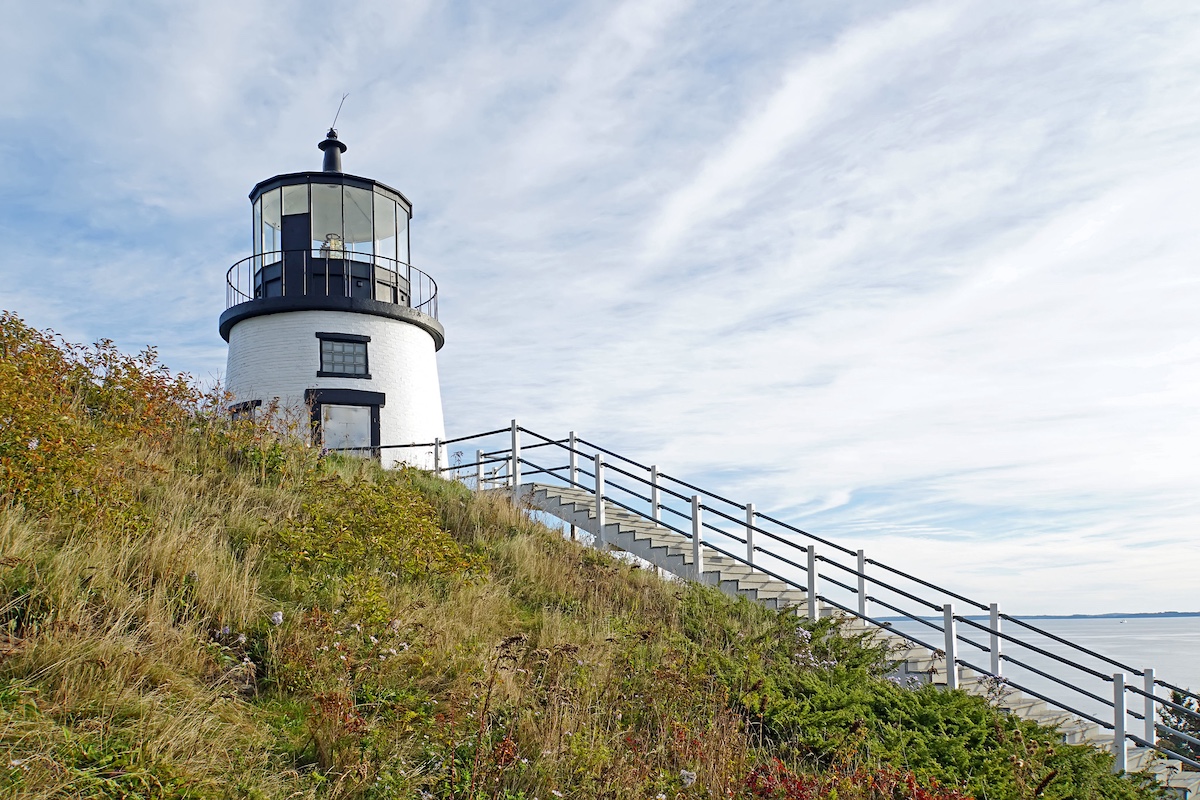
“Maine-00067 – Owls Head” by Dennis Jarvis is licensed under CC BY-SA 2.0.
Just south of Rockland, a small peninsula reaches out into Penobscot Bay, ending in a rocky headland that the early mariners thought resembled an owl’s head. The town that grew up there took the name, and today Owls Head is home to two of the most distinctive attractions in all of Mid-Coast Maine. One is a small, much-loved lighthouse perched on a cliff above the bay. The other is a world-class museum where century-old aircraft and automobiles are not merely displayed but actually started up and driven. They sit only a few minutes apart, and together they make for one of the best single days a visitor to the Rockland area can plan.
Whether you’re staying in a vacation cottage near the Samoset Resort in Rockport, exploring the Mid-Coast for the first time, or considering a move to the region, Owls Head rewards the trip. Here’s what makes both landmarks worth your time, and how to see them well.
The Town of Owls Head
Owls Head is a quiet coastal town of working lobster boats, quiet roads, and some of the finest bay views in the region. It is home to the Knox County Regional Airport, the small commercial and general-aviation airport that serves the Mid-Coast, and to Owls Head Light State Park, the modest but beautiful park that surrounds the lighthouse. The town sits just a few minutes south of downtown Rockland, which means it pairs easily with a day of exploring the city’s restaurants, galleries, and the Farnsworth Art Museum. For a place this small, Owls Head punches far above its weight in things worth seeing.
Owls Head Lighthouse: A Small Tower with a Big Presence
Owls Head Lighthouse is proof that a lighthouse does not need to be tall to be unforgettable. The light station was established in 1825, when a round rubblestone tower was first built to guide vessels into Rockland Harbor and through the busy waters of western Penobscot Bay. The present brick tower, which replaced the original, dates to 1852. It stands only about thirty feet tall, but it sits atop a rocky cliff that places the light roughly one hundred feet above the sea, so its modest stature is more than made up for by its dramatic perch. A separate keeper’s house was added in 1854.
What makes the light especially notable to lighthouse enthusiasts is that it still shines through one of the last handful of original Fresnel lenses in operation in the state of Maine. The station was automated in 1989, ending more than a century and a half of resident keepers. Since 2007, the tower has been cared for under lease by the American Lighthouse Foundation, which has been an excellent steward, and the former keeper’s house now serves as an interpretive center where visitors can learn the station’s history.
The Stories That Made Owls Head Famous
Owls Head has accumulated more than its share of memorable tales over two centuries, and two of them have become part of Maine’s lighthouse lore.
The first is the famous “frozen couple” rescue. During a fierce blizzard in December 1850, a small schooner was driven onto the ledges near Owls Head with three people aboard. As the vessel broke apart, a crewman struggled ashore through the storm to seek help while the others, a mate named Richard Ingraham and his fiancee Lydia Dyer, were left clinging to the wreck. By the time a rescue party reached them, the couple was reportedly encased in a shell of ice. According to the accounts handed down, the rescuers worked for hours to thaw and revive them, and against all odds the pair survived. The story goes that Ingraham and Dyer were married the following June. It is the kind of tale that has surely grown in the retelling, but its endurance says something about the place.
The second is the beloved story of Spot, a springer spaniel who lived at the light station in the 1930s under Keeper Augustus Hamor. As the story is told, the keeper’s family taught the clever dog to ring the station’s fog bell by pulling its rope with his teeth whenever he heard a passing vessel. On one stormy night, Spot is said to have alerted the crew of the Matinicus mail boat as it struggled toward the harbor in poor visibility, barking from the cliff’s edge until the boat found its way. Whether legend or history or a bit of both, Spot remains one of the most cherished characters in Maine lighthouse tradition.
Visiting Owls Head Lighthouse
The lighthouse sits within Owls Head Light State Park, reached by a short drive from Rockland followed by an easy walk through the woods to a stairway that climbs to the light. The effort is minimal and the payoff is enormous: from the headland you look out across Penobscot Bay toward the islands, with the Rockland Breakwater and its own lighthouse visible to the north and the Camden Hills rising in the distance. It is one of the most photographed spots on the Mid-Coast coast, and it is especially striking in the fog, when the bay turns soft and gray and the little tower does exactly the job it was built for.
The park is generally accessible year-round and is free to visit, though the interior of the tower and the interpretive center keep seasonal hours. Bring a picnic, give yourself time to sit and watch the boat traffic, and you’ll understand quickly why this small light has such a devoted following. Lighthouse lovers visiting the region will also want to read our guide to Marshall Point Lighthouse on the nearby St. George Peninsula, a natural companion outing.
The Owls Head Transportation Museum: Where History Runs
A few minutes from the lighthouse, beside the Knox County Regional Airport, sits an institution unlike any other in Maine. The Owls Head Transportation Museum was founded in 1974 by the Owls Head Foundation, an effort that began with a suggestion from Thomas J. Watson Jr., the longtime CEO of IBM, who kept a home in the area. Its mission, stated plainly, is to collect, preserve, exhibit, and operate pre-1940 aircraft, ground vehicles, engines, and related technologies for the purpose of education.
That word “operate” is what sets the museum apart. This is not a place where machines sit silent behind velvet ropes. The collection began modestly, with two automobiles, two aircraft, a high-wheel bicycle, and a hundred-ton steam engine, and has grown into a remarkable assembly of roughly 125 objects in its core holdings, including original and replica aircraft and a range of vehicles dating from the late 1890s into the 1960s. The broader operating collection numbers well over 150 antique automobiles, aircraft, motorcycles, bicycles, and engines, many of them kept in running order. On event days, visitors can watch and hear these machines come to life, which transforms transportation history from an abstraction into something you experience with your eyes and ears.
Events at the Museum
The museum’s calendar is a major part of its appeal, with more than a dozen special events through the warmer months. The Wings and Wheels Spectacular is the museum’s longest-running and most celebrated event, an air show and ground display that brings the collection’s aircraft and vehicles into action. Throughout the summer the museum hosts a series of thematic festivals devoted to antique automobiles and motorcycles, and exhibitors who arrive in a qualifying antique vehicle are typically admitted free, which means the parking areas themselves become part of the show. Each August, the New England Auto Auction, the museum’s largest annual fundraiser, draws collectors from across the country. Even on an ordinary day, the exhibits reward a couple of unhurried hours, and families in particular find it a genuine highlight of the region.
Make a Day of It in the Owls Head Area
The smartest way to experience Owls Head is to combine its two landmarks with the pleasures of nearby Rockland. Start with a morning at the Transportation Museum, walk the headland at the lighthouse in the early afternoon, and finish with dinner and a stroll on Rockland’s Main Street, perhaps after a visit to the Farnsworth Art Museum. The Owls Head General Store, a local institution, is a popular stop for a casual bite along the way. It is the kind of day that captures what the Mid-Coast does so well: history, natural beauty, working coastal character, and small-town charm, all within a few miles of one another.
Owls Head and the Mid-Coast Real Estate Picture
For visitors who find themselves reluctant to leave, Owls Head and the surrounding communities offer the quiet, water-oriented lifestyle that draws so many people to this part of Maine. The peninsula’s mix of waterfront homes, year-round neighborhoods, and proximity to Rockland’s amenities makes it an appealing place to consider for a second home or a permanent move. If a corner of the Mid-Coast like this has captured your imagination, the team at Sail Away Maine Realty knows these towns intimately and would be glad to help you explore what’s available at sailawaymaine.com.
Planning a Mid-Coast Maine getaway, or thinking about making the region home? Contact Sail Away Maine Realty and Property Management. Our offices are located in Rockport at 89 Village Way and Rockland at 66B Maverick Street. We manage oceanview vacation cottages near the Samoset Resort and work with buyers and sellers throughout the Mid-Coast. Learn more at sailawaymaine.com.