
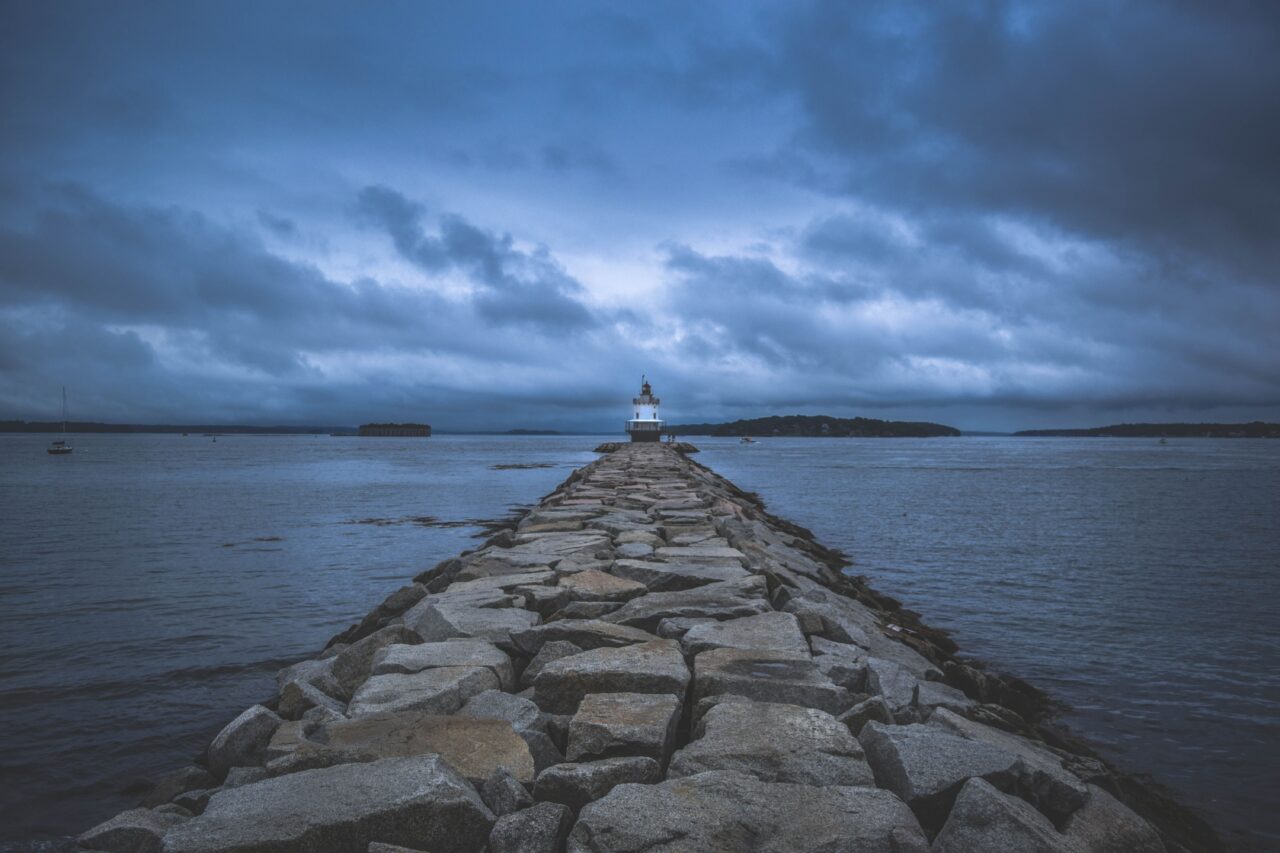
Of all the landmarks along Penobscot Bay, few reward a visitor as generously for so little effort as the Rockland Breakwater. It costs nothing, it takes under an hour, and it delivers one of the best views in Mid-Coast Maine: nearly a mile of granite walked straight out into the harbor, ending at a working lighthouse with the Camden Hills rising behind you and the open bay in front. For guests staying in our Samoset Village cottages, the breakwater is close enough to be a before-dinner walk rather than a planned excursion, and it is worth understanding both its history and its practical details before you go.
A Breakwater Built to Save a Harbor
The Rockland Breakwater exists because the harbor it protects nearly did not survive the nineteenth century. A series of severe nor’easters in the 1850s battered Rockland’s waterfront, damaging wharves, businesses, and ships anchored in what was, at the time, an unprotected harbor. Local citizens and a state senator petitioned Congress for relief, but funding did not arrive until 1880, when Congress finally approved construction of a breakwater. The original plan called for two separate structures, one running from Jameson Point and another from South Ledge, but by 1890 engineers had settled on a single, continuous breakwater as the better design.
Construction stretched on for nearly two decades. Crews began placing stone in 1881 and did not complete the roughly 4,300-foot breakwater, using more than 768,000 tons of granite, until November 24, 1899. That first winter proved the structure needed to sit higher above the waves, and workers added a four-foot cap in 1901 that also formed the foundation for a lighthouse. It is a common misconception that the breakwater was built to reach an existing light. In fact, the stone wall came first, and the lighthouse followed only after the harbor already depended on the protection the breakwater provided.
The Lighthouse Rises
Before a permanent lighthouse existed, mariners had only a temporary beacon to mark the breakwater’s exposed end, starting with a simple lantern hung from an iron crane and later upgraded to a pair of red lanterns on a mast. The permanent Rockland Breakwater Lighthouse, built by the W. H. Glover Company of Rockland, went up between 1900 and 1902: a 25-foot brick tower attached to a wood-and-brick keeper’s dwelling, originally fitted with a fourth-order Fresnel lens. The light was automated in 1965, ending the era of resident keepers, and today it remains an active aid to navigation maintained by the U.S. Coast Guard, still flashing white every five seconds and sounding its fog signal when the bay closes in.
Ownership passed to the City of Rockland through the Maine Lights program in the late 1990s, and for two decades the Friends of Rockland Breakwater Lighthouse, a chapter of the American Lighthouse Foundation, leased and cared for the station, restoring the keeper’s house and opening the tower to visitors on select days. The lighthouse and its museum spaces continue to depend on this kind of volunteer stewardship, so access to the tower interior varies by season and ongoing restoration work. The breakwater walk and the exterior of the lighthouse, however, are open to the public year-round, weather permitting, which is what draws most visitors in the first place.
Walking the Breakwater
The walk itself is the real experience, and it is simpler than people expect. Parking is free along Samoset Road in Rockland, a short walk or drive from our Samoset Village cottages, with roughly three dozen spaces near where the road dead-ends at the small waterside park. From there, the breakwater stretches almost a mile out into the harbor, a wide, flat granite causeway that makes for an easy round trip of well under two miles. Dogs are welcome on leash, and the surface, while uneven granite rather than pavement, is manageable for most walkers in ordinary sneakers. Give yourself forty-five minutes to an hour for the round trip if you plan to linger at the light, longer if you brought a camera or a picnic.
The views along the way are the real payoff. Looking back toward shore, you get one of the classic Rockland vistas, with the Samoset Resort’s oceanfront golf course and the Camden Hills forming the backdrop. Looking outward, Penobscot Bay opens up in front of you, often dotted with sailboats, lobster boats, and the occasional windjammer running under full sail. Sunset is an especially popular time to walk, when the granite and the lighthouse both catch the evening light, though an early morning walk rewards you with quieter surroundings and good odds of spotting seals or seabirds along the rocks.
Practical Tips Before You Go
Footing on the granite blocks is uneven in places, so sturdy shoes matter more than fashion. The breakwater has essentially no shade and very little shelter, so check the forecast and dress for wind, which tends to pick up noticeably as you get farther from shore, even on a warm day. There are no restrooms or concessions at the park or along the breakwater itself, so plan accordingly before you set out. A portable restroom is placed near the parking area during the warmer months. Because the lighthouse and museum interiors operate on a limited seasonal schedule tied to volunteer staffing and restoration work, check current visiting hours before making the walk specifically to see the inside of the tower, though the exterior and the walk itself are worth the trip regardless.
The Best Times to Walk It
The breakwater rewards visitors at almost any hour, but a few windows stand out. Early morning brings calm water, soft light, and the best odds of having the granite mostly to yourself, along with a good chance of spotting harbor seals hauled out on nearby rocks. Midday works well for families and casual visitors, when the light is flattest but the footing is easiest to see clearly. Evening, especially in the hour before sunset, is when the breakwater draws its biggest crowd of photographers and locals alike, as the light turns the water gold and silhouettes the lighthouse against the Camden Hills. Whatever time you choose, checking the tide and wind forecast beforehand is worth the extra minute, since a stiff onshore breeze makes the outer third of the walk considerably brisker than the parking area might suggest.
Pairing the Breakwater with the Rest of Your Day
The breakwater sits within easy reach of nearly everything else that makes a Mid-Coast Maine day complete. Downtown Rockland, with its restaurants and the Farnsworth Art Museum, is a short drive away, as is the Maine State Ferry Service terminal for day trips to Vinalhaven or North Haven. Golfers can follow the walk with a round at the Samoset Resort course next door, and anyone who enjoyed the granite causeway will likely enjoy our earlier feature on the Owls Head Lighthouse and Transportation Museum a few miles farther down the peninsula, another classic Mid-Coast lighthouse outing with a very different personality.
Stay Close Enough to Walk It Twice
Guests in our Samoset Village oceanview cottages are close enough to the Rockland Breakwater to make it a regular part of the week rather than a single outing, a sunset walk one evening and a quiet morning walk the next. It is one of the small advantages of basing your Mid-Coast Maine vacation in Rockport, where the best of Rockland, Camden, and the bay itself are all within a few minutes’ drive.
Contact Sail Away Maine Realty and Property Management to inquire about cottage availability and rates. Call (207) 593-7065. Our offices are located in Rockport at 89 Village Way and Rockland at 66B Maverick Street. View current listings at sailawaymaine.com.